
How Does Same-Day 3D-Printed Restoration with the Midas Printer Work?
Quick answer: Same-day 3D-printed restoration uses a chairside printer — such as the SprintRay Midas — to design and produce a crown, veneer, inlay or onlay in a single appointment. The tooth is digitally scanned, AI helps design the restoration, and the printer fabricates it from a ceramic-filled resin in minutes, so it can be fitted the same day without a temporary or a separate lab visit.
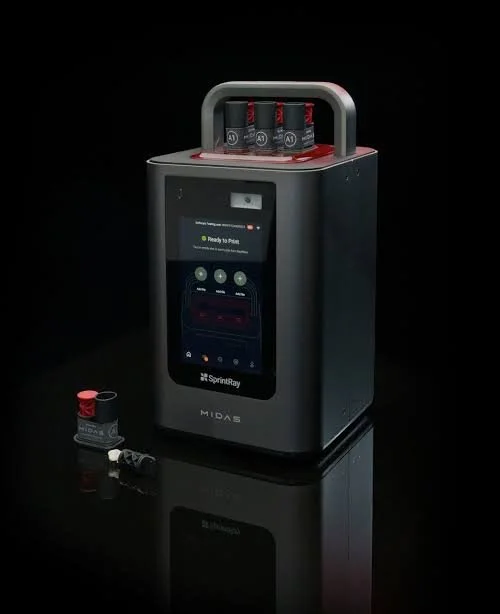
Walking out of a single appointment with a finished, fixed restoration — no two-week wait, no temporary crown, no second injection — used to belong to a small number of practices with large milling units. 3D printing is changing that. This post explains what same-day printed restorations are, how the Midas printer fits into a modern digital workflow, what it can and can't do, and how to think about it as a patient.
What "same-day restoration" actually means
A traditional crown or veneer involves two visits. At the first, the tooth is prepared, an impression is taken, and a temporary restoration is fitted while a dental laboratory makes the definitive one. You return a couple of weeks later to have the temporary removed and the final restoration bonded or cemented.
A same-day, or "chairside," workflow collapses that into one appointment. The tooth is prepared and scanned with a digital intra-oral scanner instead of a putty impression, the restoration is designed on-screen, it is manufactured in the practice, and it is fitted before you leave. The two technologies that make this possible are chairside milling (carving a restoration out of a solid block) and, more recently, chairside 3D printing (building it up in layers).
What is the Midas printer?
The SprintRay Midas is a compact 3D printer built specifically for producing dental restorations at the chairside, rather than a general-purpose printer adapted for dental use. It is designed to take a case from digital scan to fitted restoration within a single visit, removing the lab turnaround and the temporary stage in between.
Its defining feature is a printing method SprintRay calls Digital Press Stereolithography (DPS). Conventional resin printers struggle with the thick, highly-filled ceramic resins that make a strong restoration, because those materials are too viscous to flow through a standard tank. DPS replaces the usual resin tank, bottle and permanent build platform with a single-use resin capsule and uses pressure to shape the material — which is why the system can work with ceramic-dominant resins that ordinary printers can't handle.
In practical terms, SprintRay reports the Midas can produce around three crowns, six inlays/onlays, or nine veneers in under ten minutes of print time, with the full design-print-cure cycle taking roughly half an hour.
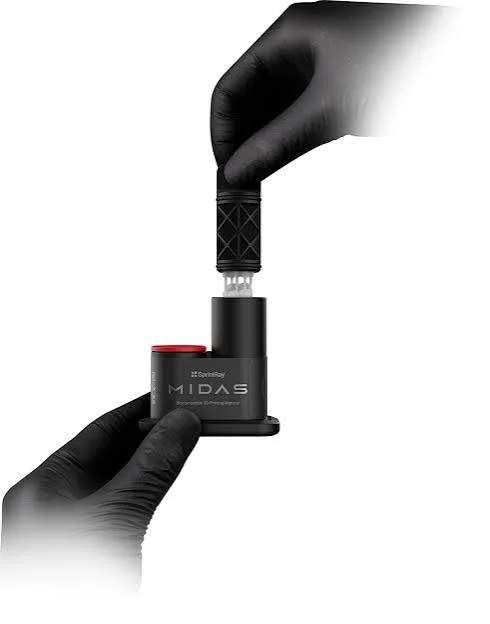
How the workflow runs, step by step
Preparation. The clinician prepares the tooth as they would for any crown, inlay, onlay or veneer.
Digital scan. An intra-oral scanner captures the tooth and surrounding teeth — no impression material.
AI-assisted design. SprintRay's cloud-based AI Studio software proposes a restoration design from the scan, which the clinician reviews and refines. This removes the need for separate CAD expertise.
Printing. The Midas prints the restoration from a ceramic-filled resin capsule in minutes.
Curing and finishing. The printed restoration is post-cured, then finished and polished using standard chairside techniques.
Fit. It is bonded or cemented the same day, often while you are still numb — so any small adjustment can be made on the spot.
The materials: are 3D-printed restorations strong enough?
This is the question that matters most, and it's worth answering honestly.
The definitive (permanent) resins developed for the Midas — such as SprintRay's Crown HT and Ceramic Crown — are ceramic-filled hybrid materials, with more than 60% ceramic content in the case of Crown HT. They are regulatory-cleared, biocompatible medical-grade materials intended for definitive crowns, inlays, onlays and veneers, available in a range of tooth shades to blend with your natural teeth. They are designed to mimic the way natural enamel diffuses light, which is what gives a restoration a lifelike rather than "flat" appearance.
It's also fair to set expectations. Printed restorative materials are a newer category than milled lithium disilicate (e.g. e.max), which has a long clinical track record. Independent laboratory studies are still building the evidence base, and some research notes that printed resins can show a lower elastic modulus and rougher surface after simulated ageing than milled ceramic. For many everyday restorations the printed materials perform well, but the right choice depends on the tooth, the bite forces involved, and aesthetic demands — which is a clinical judgement your dentist makes case by case.
Who is a good candidate?
Same-day printed restorations can be a strong option if you:
need a single crown, inlay, onlay or veneer and want it done in one visit
dislike conventional putty impressions or have a strong gag reflex
find it difficult to attend multiple appointments (work, travel, time off)
want to avoid wearing a temporary crown between visits
They may be less suitable for complex aesthetic cases, very heavy grinders/clenchers, or situations where a material with a longer track record is clinically preferable. A consultation is the only way to know which approach fits your tooth.
Frequently asked questions
Is a 3D-printed crown a permanent crown? Yes — the Midas uses definitive, regulatory-cleared ceramic-filled resins (such as Crown HT and Ceramic Crown) intended for permanent restorations, not just temporaries. Your dentist will confirm whether a printed restoration is the right definitive choice for your specific tooth.
How long does a same-day printed restoration take? Print time for the restoration itself is typically under ten minutes, with the full appointment — preparation, scanning, design, printing, curing and fitting — usually completed in a single visit.
Does it hurt more than a normal crown? No. The preparation and fitting are the same as for a conventional crown; the difference is that everything happens in one appointment, so there's no second numbing visit and no temporary to manage.
Are 3D-printed restorations as good as milled or lab-made ones? The materials are clinically cleared and perform well for many restorations, with the major advantage of speed and a single visit. Milled lithium disilicate has a longer track record, and the best option depends on your individual case — something your dentist will discuss with you.