Restorative dentistry · A compromised tooth
A broken, cracked or heavily filled tooth
Large failing fillings, cracks and fractures weaken a tooth. Treatment depends on how much is damaged, from a filling or build-up to a protective overlay or crown. Here are your options, side by side.
What is a compromised tooth?
When a tooth is weakened
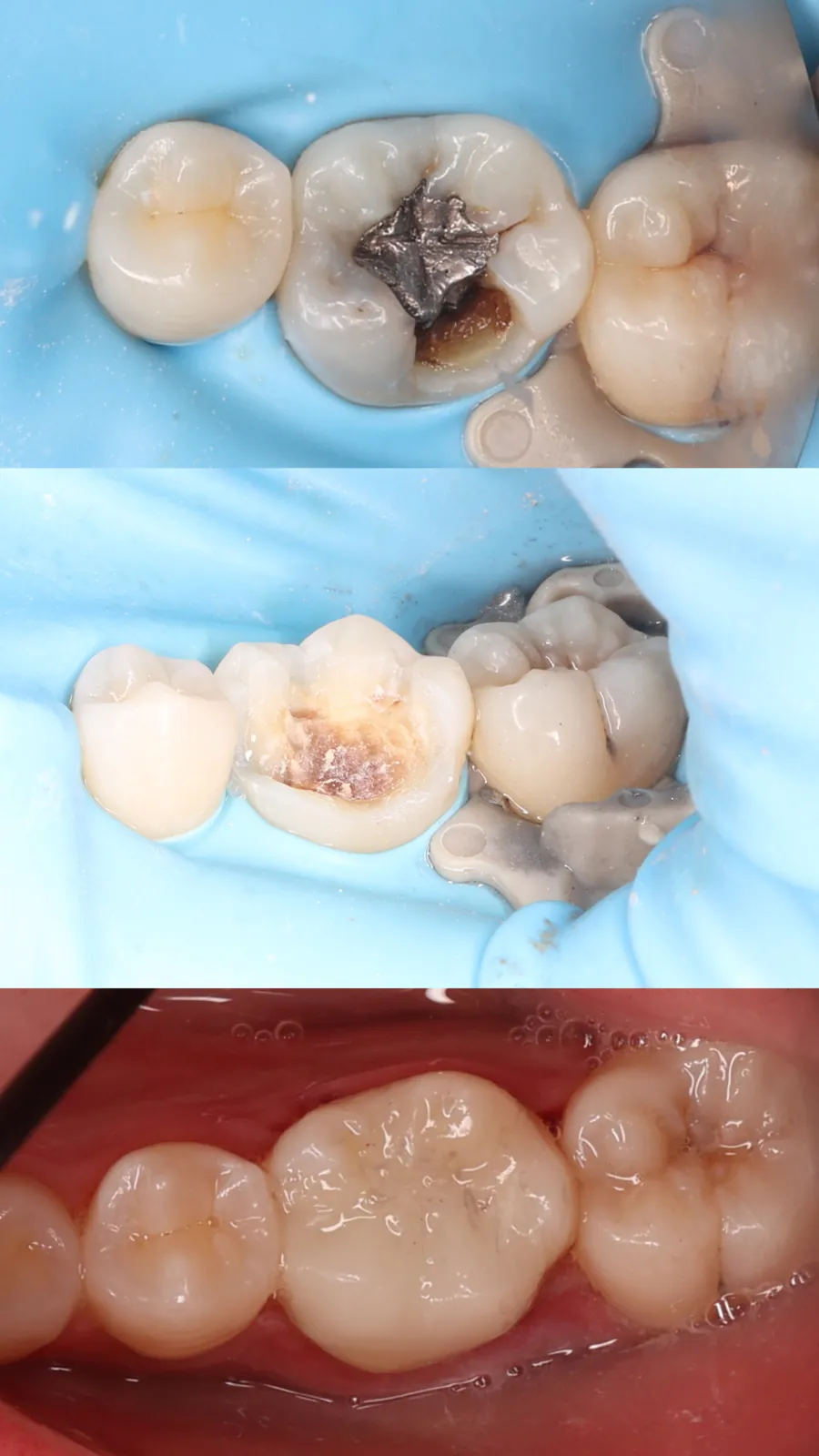
A tooth with a large, failing filling, a crack or a fracture, often a back tooth, and often one that has had root canal treatment.
The more of a tooth that has been filled or lost, the weaker the walls and cusps that are left. Under biting forces they can flex, crack and eventually break, sometimes below the gum where the tooth can't be saved.
Signs to look out for: a sharp pain when you bite on something, sensitivity to cold, food catching in a gap, a filling that keeps failing, or a piece of tooth breaking off.
Treatment depends on the extent of the damage. A smaller problem may only need a filling or a build-up. A tooth that is badly weakened is best protected by covering its cusps with an overlay, or the whole tooth with a crown.
- Treatment matched to how much tooth is damaged
- Same-day 3D printed overlays from our own lab
- Every option and cost written down before we start
Your options
Three ways to restore a compromised tooth
Every tooth is different. We'll tell you which options suit yours, and why.
| Direct composite overlayOption 1 | 3D printed overlayOption 2 | Ceramic crown or overlayGold standard | Do nothingNot recommended | |
|---|---|---|---|---|
| What it is | The compromised part of the tooth is removed and a white filling is built up directly, often covering much of the biting surface | A ceramic-resin inlay, onlay or overlay, designed from a digital scan and printed in our own lab | Made by our dental laboratory in E.max ceramic: an overlay protects the cusps, a crown caps the whole tooth | Leaving the tooth as it is |
| Visits | One | One: made the same day, with no temporary | Two, with a temporary in between | None |
| How much tooth is removed | Only the damaged part | Only the damaged part | An overlay keeps more of your tooth than a crown | None now, but more is usually lost later |
| Expected lifespan | 3–5 years | 5–7+ years | 10–15+ years | A crack doesn't heal on its own |
| Good to know | The contacts between teeth can be less precise than with a made-to-measure restoration | For larger defects where a direct filling could be weak; a newer material with less long-term data | The strongest, most natural-looking and longest-lasting choice | The crack can spread, leading to pain, a larger break or losing the tooth, and treatment then becomes harder |
| Investment | More affordable | Higher investment | Highest investment | Not recommended |
| About fillings | Inside our lab | Crowns & overlays |
Direct composite overlay
Option 1
- What it is
- The compromised part of the tooth is removed and a white filling is built up directly, often covering much of the biting surface
- Visits
- One
- How much tooth is removed
- Only the damaged part
- Expected lifespan
- 3–5 years
- Good to know
- The contacts between teeth can be less precise than with a made-to-measure restoration
- Investment
- More affordable
3D printed overlay
Option 2
- What it is
- A ceramic-resin inlay, onlay or overlay, designed from a digital scan and printed in our own lab
- Visits
- One: made the same day, with no temporary
- How much tooth is removed
- Only the damaged part
- Expected lifespan
- 5–7+ years
- Good to know
- For larger defects where a direct filling could be weak; a newer material with less long-term data
- Investment
- Higher investment
Ceramic crown or overlay
Gold standard
- What it is
- Made by our dental laboratory in E.max ceramic: an overlay protects the cusps, a crown caps the whole tooth
- Visits
- Two, with a temporary in between
- How much tooth is removed
- An overlay keeps more of your tooth than a crown
- Expected lifespan
- 10–15+ years
- Good to know
- The strongest, most natural-looking and longest-lasting choice
- Investment
- Highest investment
Do nothing
Not recommended
- What it is
- Leaving the tooth as it is
- Visits
- None
- How much tooth is removed
- None now, but more is usually lost later
- Expected lifespan
- A crack doesn't heal on its own
- Good to know
- The crack can spread, leading to pain, a larger break or losing the tooth, and treatment then becomes harder
- Investment
- Not recommended
Gold and metal overlays and crowns are also available, and are very hard-wearing for heavy grinders. Use the cost estimator below to compare prices.
How long they last
Longevity, honestly
Direct filling or composite overlay5+ years
Completed in one visit. Large fillings last less: 3–5 years, or 2–3 years if very large
3D printed restoration or overlay7+ years
Made in our lab while you wait; a more anatomical shape and better contacts than a filling
Ceramic crown or overlay10+ years
Lab-made E.max or zirconia ceramic: the longest-lasting tooth-coloured option
Gold overlay or crown10+ years
Very hard-wearing, and kind to the opposing teeth
Typical figures, not guarantees. How long a restoration lasts depends on your bite, grinding, cleaning and regular check-ups. A night guard protects restorations if you grind.
Cost estimator
What might restoring your tooth cost?
Two quick questions compare the ways to restore a cracked, decayed or broken-down back tooth: what each costs, how long it tends to last and how we rate it for your tooth.
Single compromised tooth cost estimator
For a cracked, decayed or broken-down back tooth with no pain, or mild to moderate symptoms. If it's severely painful, swollen or keeping you awake, book an emergency appointment instead.
Based on a typical first molar. Teeth further back take stronger biting forces and may need a different or stronger restoration, such as gold. Your dentist will advise.
Indicative cost
–
Spread the cost over 12 months with no interest on qualifying treatment. Jasmine, our patient coordinator, helps you apply in a few minutes. Subject to status. We are a credit broker, not a lender: finance details.
Indicative only. Lifespans are typical, not guaranteed. Your dentist confirms which options suit your tooth, with every cost in a written plan before treatment.
Book a consultationHow we look after a compromised tooth
Assess
We check the tooth, the crack and your bite, with X-rays and photographs, to see how much of it is sound.
Explain
We talk you through the options that suit your tooth, with their lifespans and costs written down.
Restore
A composite or 3D printed overlay is done in one visit. A lab-made ceramic overlay or crown takes two.
Protect
If you grind or clench, a hard night guard helps protect the tooth and the restoration.
After root canal treatment
A back tooth that has had root canal treatment is more brittle and more likely to crack. Covering its cusps with an overlay or crown is usually recommended to protect it. See root canal treatment.
Prices
Prices for a compromised tooth
All our prices are kept in one place, on our fees page, so they are always up to date. Your written treatment plan confirms every fee before anything begins, and 0% finance over 12 months is available on qualifying treatment, subject to status.
Questions
A compromised tooth FAQs
Will a cracked tooth heal on its own?
No. Unlike bone, a crack in a tooth doesn't heal, and it tends to spread under biting forces. Protecting the tooth early usually means a simpler, cheaper and more predictable treatment.
Which option is best for my tooth?
It depends on how much tooth is left, where the crack runs, your bite and whether the tooth has had root canal treatment. We'll explain which options suit your tooth and why, with every cost in writing, before anything is done.
What is the difference between an overlay and a crown?
An overlay covers and protects the biting surface and cusps, keeping the healthy side walls of your tooth. A crown covers the whole visible tooth. Where we can, we choose an overlay because it keeps more of your own tooth.
Is it done in one visit?
A direct composite overlay and a 3D printed overlay are both completed in a single visit. A lab-made ceramic crown or overlay takes two visits, with a temporary in between.
Related treatments